Key Takeaways
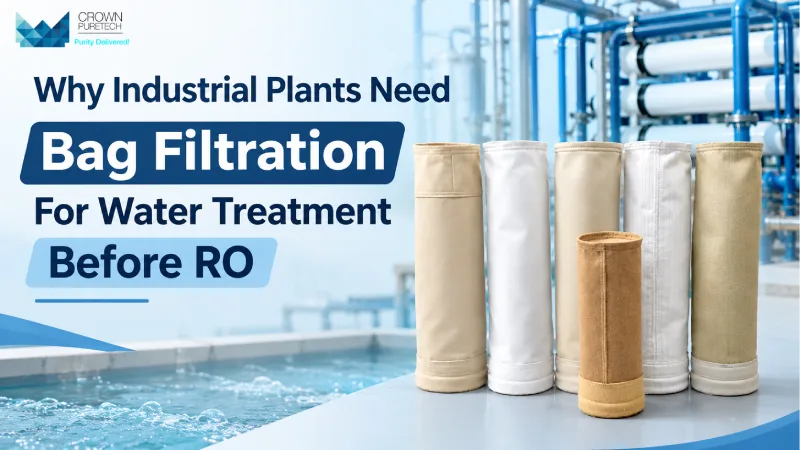
- Bag Filtration For Water Treatment is essential for minimizing particulate contamination in industrial RO plants.
- Choosing the right bag filter micron rating impacts filtration efficiency and maintenance frequency.
- Effective bag filtration protects downstream RO membranes from fouling by capturing suspended solids.
- Regular monitoring of bag filter performance helps ensure reliable operation and reduce maintenance issues.
- Bag Filtration For Water Treatment effectively removes suspended particles, minimizing fouling and extending the life of RO membranes.
Crown Puretech is a provider of industrial water filtration equipment, including bag filters and RO pretreatment solutions. In industrial RO plants, suspended particles can create serious operating problems when they reach sensitive downstream components. Bag Filtration For Water Treatment helps remove sediment and particulate impurities before water enters finer filtration stages. But does every RO plant need a bag filter? The answer depends on feed-water quality, particle loading, and the pretreatment arrangement.
Why Should Industrial RO Plants Filter Water Before the Membrane?
RO membranes are designed primarily to separate dissolved salts and other contaminants from water. They are not intended to handle heavy concentrations of sand, rust, silt, and suspended solids directly.
When excessive particles enter an RO system, they can accumulate on membrane surfaces and inside flow channels. This contributes to fouling, restricts water movement, and makes cleaning more frequent.
Factories using borewell water, surface water, or water from storage tanks may encounter different levels of suspended impurities.
Effective pretreatment reduces the particulate load reaching the RO membranes and helps maintain more stable operation.
However, particulate filtration alone cannot control every type of membrane fouling. Biological growth, scaling, and certain organic contaminants may require additional treatment.
How Does Bag Filtration Work Before RO?
A bag filtration system operates with a replaceable filter bag fitted within a housing designed to withstand operating pressure. Water enters the housing and passes through the selected filtration material.
Particles larger than the filter's effective retention range are captured, while filtered water moves towards the next treatment stage.
A typical arrangement works as follows:
- Water Inlet: Untreated water enters the bag filter housing through the designated inlet connection.
- Suspended particles are retained: The filter media captures particles according to its rating and construction.
- Filtered water exits: Water travels towards cartridge filtration or another pretreatment component.
- Collected solids accumulate: The bag gradually becomes loaded with retained particles.
- The bag is replaced: Maintenance personnel replace the bag when operating conditions indicate it is necessary.
The arrangement is mechanically straightforward, but performance depends on the chosen micron rating, filtration media, flow rate, and housing design.
What Problems Can Bag Filters Help Reduce?
For industrial facilities, Bag Filtration For Water Treatment provides an additional barrier against particulate contamination.
Its main advantages include:
- Reduced sediment carryover: Captures selected suspended particles before they reach finer filters.
- Better downstream protection: Helps reduce particulate loading on cartridge filters and RO membranes.
- Simpler solids removal: Retained particles can be removed through bag replacement.
- Flexible filtration: Different micron ratings accommodate different pretreatment requirements.
- Operational monitoring: Pressure readings help operators identify increasing filter resistance.
These benefits depend on correct equipment selection.
A bag filter cannot remove dissolved salts, and it should not be treated as a substitute for the RO membrane itself.
Bag Filter vs Cartridge Filter: What Is the Difference?
Both technologies are used to control particulate contamination, but they may serve different positions within a water treatment plant.
|
Selection Factor |
Bag Filter |
Cartridge Filter |
|
Common application |
Bulk particulate filtration |
Finer particulate filtration |
|
Filter element |
Replaceable bag |
Replaceable cartridge |
|
Particle retention |
Depends on bag micron rating |
Depends on cartridge micron rating |
|
Maintenance |
Bag replacement |
Cartridge replacement |
|
RO pretreatment role |
Often an upstream stage |
Often a final particulate barrier |
A bag filter followed by a suitably rated cartridge filter can provide staged particulate removal where the incoming water quality requires it.
The best filtration sequence is determined by feed-water characteristics, not by assuming one filter type is always superior.
How to Choose the Right Micron Rating
One of the most important decisions is selecting an appropriate filter rating.
A smaller micron rating can capture finer particles, but it may also increase flow resistance or require more frequent filter changes if the incoming water contains substantial suspended solids.
A larger rating may handle heavier particulate loading but allow smaller particles to pass through.
Before choosing a Bag filter for water treatment in Ahmedabad, industrial buyers should review:
- Feed-water turbidity and suspended-solids concentration
- Type and approximate size of particles present
- Required operating flow rate
- Downstream cartridge and membrane requirements
- Acceptable pressure drop across the filter
- Filter bag replacement frequency
Also ask whether the stated micron rating is nominal or absolute. These terms describe different particle-retention characteristics and should not be treated as interchangeable.
Where Should Bag Filtration Be Installed?
Industrial pretreatment systems commonly use several treatment stages rather than relying on a single filter.
Depending on the source water, the arrangement may include multimedia filtration, activated carbon treatment, softening, chemical dosing, bag filtration, and cartridge filtration.
Bag filters can be positioned upstream of cartridge filters where suspended-solids loading justifies their use.
At Crown Puretech, our imported bag filters are intended for industrial water treatment, RO pretreatment, process-water filtration, and utility water applications.
The appropriate installation position should be decided after reviewing the complete treatment process.
When Does a Bag Filter Need Replacement?
A dirty bag can restrict water flow, while a damaged or incorrectly installed bag can allow particles to bypass the filtration media.
Operators should monitor the pressure difference between the inlet and outlet, along with changes in flow and water quality.
Common maintenance indicators include rising differential pressure, reduced throughput, visible sediment accumulation, or filtration performance falling below requirements.
Replacement intervals vary because different water sources contain different particulate loads.
Do not wait for complete blockage before checking filter condition.
Regular inspection helps identify problems before they affect downstream equipment.
Why Choose Us?
At Crown Puretech, we provide imported bag filtration solutions for industrial and commercial water treatment applications. Our team helps customers review incoming water quality, filtration requirements, particle characteristics, and operating flow rates before selecting suitable equipment. If you need a Bag filter for water treatment in Gujarat, we can help you evaluate micron-rating options and their role within your existing RO pretreatment arrangement. Our focus is practical filtration that supports reliable plant operation and effective equipment protection.
Conclusion
Bag filtration plays an important role in industrial RO pretreatment when suspended particles are present in the feed water.
It helps reduce particulate loading before water reaches finer filtration components and RO membranes. However, bag filters do not remove dissolved salts or replace other necessary pretreatment processes.
For the best results, factories should evaluate their source water, select appropriate filtration ratings, and monitor pressure drop during operation.
Choosing Bag Filtration For Water Treatment based on actual plant conditions can reduce avoidable maintenance concerns and support better overall pretreatment performance.
Need reliable bag filtration for your industrial RO plant?
Contact Crown Puretech to discuss suitable bag filter options for your feed-water quality, flow rate, and filtration requirements.
Call: +91 98987 79911
Email: sales@crownpuretech.com
Share your plant requirements with our team and get guidance on the right filtration solution.
Frequently Asked Questions
01Why is bag filtration important for water treatment in industrial RO plants?
Bag filtration is crucial for removing suspended particles and sediment before water enters the RO membranes. This helps prevent fouling, reduces maintenance needs, and enhances the overall operation of the water treatment system.
02What factors should I consider when selecting a bag filter for water treatment in Ahmedabad?
When choosing a bag filter, consider the feed-water turbidity, suspended-solid concentration, required flow rate, and micron rating. These factors will help ensure the selected filter effectively meets your industrial water treatment needs.
03How does bag filtration work before RO in water treatment systems?
Bag filtration systems use replaceable filter bags that capture particles larger than their effective retention range. Untreated water flows into the housing, where the filter bag retains the suspended solids before the filtered water moves on to further treatment stages.
04Can bag filters replace cartridge filters in water treatment?
Bag filters and cartridge filters serve different roles in water treatment. Bag filters are typically used for bulk particulate filtration, while cartridge filters provide finer filtration. Ideally, they are combined in a treatment system to ensure effective particle removal.
05What maintenance indicators suggest that a bag filter needs replacement?
Key maintenance indicators for bag filters include rising differential pressure, decreased flow rate, visible sediment build-up, and reduced filtration performance. Regular monitoring ensures timely replacement and helps maintain optimal operation of the water treatment system.