Key Takeaways
- Nano Micron Filters are essential for capturing fine suspended particles in water before further treatment stages.
- Understanding micron ratings helps users select the right Nano Micron Filter for their specific water quality needs.
- Proper installation of micron filters can significantly enhance water clarity and protect downstream equipment.
- Micron filters can effectively remove impurities like fine sand, rust, and suspended sediment, improving overall water quality.
- It's important to confirm the intended application when comparing products like the Sicce Micron Internal Filter with industrial filters.
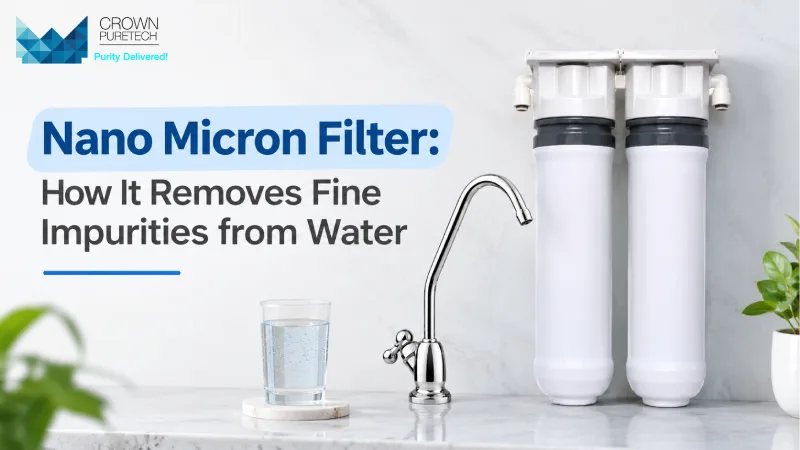
Crown Puretech is a provider of nano and micron filtration solutions for commercial and industrial water treatment applications. Water may look clean while still containing fine suspended particles that affect equipment and process performance.
A Nano Micron Filter helps capture selected particulate impurities before water moves to subsequent treatment stages. Understanding how micron ratings work, what these filters remove, and where they should be installed helps buyers choose filtration equipment that matches their water quality needs.
How Does a Nano Micron Filter Remove Impurities?
A micron filter uses filtration media with a specified particle-retention capability.
As water passes through the filter, suspended particles are retained according to the filter material, construction, and rating. Filtered water then moves towards the outlet or next treatment stage.
The basic process involves:
- Water enters the filter: Incoming water reaches the filtration element.
- Particles are retained: The media traps suspended impurities within its effective filtration range.
- Filtered water exits: Water continues towards storage, process equipment, or additional treatment.
- The filter accumulates solids: Retained particles gradually increase resistance to flow.
- Maintenance is performed: The element is cleaned or replaced according to its design and operating condition.
The filtering process is relatively simple, but selecting the correct element is important.
A smaller micron rating does not automatically mean a filter is better for every application.
What Does Micron Rating Actually Mean?
A micron, also called a micrometre, is a unit used to describe very small dimensions.
In water filtration, micron ratings help indicate the size of particles a filter is designed to capture.
For example, a filter rated at 5 microns generally targets finer particles than a filter rated at 20 microns.
However, actual retention performance depends on how the manufacturer defines and tests the rating.
Two important terms are:
- Nominal rating: Indicates particle retention under the manufacturer's specified test conditions.
- Absolute rating: Indicates a more precisely defined retention level under specified testing conditions.
These terms are not interchangeable, and performance should be checked using the manufacturer's stated test method.
When selecting a Nano Micron Filter, buyers should ask for the rated retention efficiency rather than relying on the micron number alone.
What Impurities Can Micron Filters Remove?
Micron filtration is mainly useful for reducing suspended particulate contamination.
Depending on the selected media and rating, these filters may retain:
- Fine sand and silt
- Rust particles from pipelines
- Suspended sediment
- Certain particulate residues
- Other particles within the filter's effective retention range
A micron filter does not automatically remove dissolved salts, hardness minerals, or dissolved chemicals.
It also should not be treated as a complete disinfection system unless the specific filtration technology has been validated for the required microbial reduction.
The filter's job is to remove the impurities it is designed to retain, not every contaminant present in water.
This distinction matters when planning industrial and commercial water treatment systems.
Nano Micron Filter vs Conventional Sediment Filter
The performance difference between filtration products depends on their actual specifications, not simply on the product name.
|
Selection Factor |
Fine Micron Filter |
Coarser Sediment Filter |
|
Primary purpose |
Fine particulate removal |
Larger sediment removal |
|
Particle retention |
Based on finer selected rating |
Based on coarser selected rating |
|
Pressure resistance |
May increase with tighter filtration |
Often lower at similar loading |
|
Maintenance frequency |
Depends on particle loading |
Depends on particle loading |
|
Typical placement |
Downstream polishing or pretreatment |
Earlier filtration stage |
For heavily contaminated water, a coarser filtration stage before a finer filter can reduce the amount of material reaching the final element.
This staged arrangement may simplify maintenance and limit premature blockage.
Where Are Nano Micron Filters Used?
Fine filtration is relevant wherever suspended particles can interfere with water quality or equipment operation.
At Crown Puretech, our Nano/Micron filtration solutions are intended for selected commercial and industrial applications.
Common uses include:
- Industrial process water: Reducing particles that may interfere with production equipment.
- Commercial water systems: Improving clarity where particulate removal is required.
- RO pretreatment: Reducing suspended-solids loading before sensitive downstream filtration stages.
- Utility water: Controlling particles in water used by supporting equipment.
The correct position depends on the overall treatment arrangement.
A filter used before an RO membrane may need different performance characteristics from one used for general water clarification.
What About the Sicce Micron Internal Filter?
Buyers searching for a Sicce Micron Internal Filter may encounter the term alongside other micron filtration products.
However, these products serve different applications.
Sicce's Micron and Nano Micron internal filters are designed mainly for small aquariums and turtle tanks. They use compact internal filtration arrangements, with mechanical filtration and model-dependent additional media.
Crown Puretech's Nano/Micron filtration solutions are presented for industrial and commercial water treatment applications.
An aquarium internal filter should not be confused with an industrial water filtration element simply because both use the word “Micron.”
Always confirm the intended application before comparing two filtration products.
How to Select the Right Filter for Your System
Choosing a Nano Micron Filter requires more information than the desired water clarity.
Before selecting equipment, review:
- Source water quality: Identify the types and concentration of suspended particles.
- Micron rating: Match particle retention to the treatment objective.
- Operating pressure: Confirm that the product is suitable for system conditions.
- Flow requirements: Select equipment capable of handling the required water volume.
- Water temperature: Check the filter's operating temperature limits.
- Replacement requirements: Understand the maintenance and service-life conditions.
For our listed filtration product, specifications include a pressure range of 150–1,000 kPa, a stated temperature value of 80°C, Nano-ACT film with KX CTO filter material, and a listed service life of 4,500 litres.
These are product listing values; actual suitability must be checked against the manufacturer's detailed operating instructions.
What Causes Fine Filters to Block Quickly?
Frequent blockage usually indicates that the filtration element is receiving more particulate material than it can comfortably handle.
Possible causes include high suspended-solids loading, an unsuitable micron rating, insufficient upstream filtration, or changing raw water conditions.
A filter that blocks unusually quickly may require additional pretreatment rather than simply more frequent replacement.
Operators should monitor pressure drop, water flow, and visible changes in water quality.
If performance deteriorates, inspect the element and upstream treatment arrangement before selecting a replacement.
Why Choose Us?
At Crown Puretech, we offer Nano/Micron filtration solutions designed around different water quality and particle-retention requirements. Our team helps industrial and commercial buyers review filter ratings, water pressure, operating conditions, and downstream equipment needs. We focus on selecting appropriate filtration technology rather than recommending finer filtration without a clear purpose. Whether your application involves process water, utility water, or RO pretreatment, we can help you understand the available product specifications and practical maintenance considerations.
Conclusion
A Nano Micron Filter helps remove fine suspended impurities by passing water through specially selected filtration media.
Its effectiveness depends on particle size, filter rating, material construction, water quality, and operating conditions.
The right filter can improve water clarity and reduce particulate loading on downstream treatment equipment. However, micron filtration alone does not replace RO treatment, chemical removal, or disinfection when those processes are required.
For better performance, choose the filter based on your specific application rather than its name or micron rating alone.
Need fine particle filtration for your industrial or commercial water treatment system?
Contact Crown Puretech to discuss Nano/Micron filtration options, product specifications, and compatibility with your existing treatment arrangement.
Call: +91 98987 79911
Email: sales@crownpuretech.com
Speak with our team to find a filtration solution that fits your water quality requirements.
Frequently Asked Questions
01How does a Nano Micron Filter work to remove impurities from water?
A Nano Micron Filter uses specialized filtration media to retain suspended particles as water passes through. The filter captures impurities based on its material, construction, and micron rating, allowing filtered water to move to the next treatment stage.
02What types of impurities can a Nano Micron Filter remove?
Nano Micron Filters effectively reduce suspended particulate contamination, including fine sand, rust particles, and certain residues. However, they do not remove dissolved salts or chemicals, so it’s important to understand their limitations when planning water treatment systems.
03What is the difference between a Nano Micron Filter and a conventional sediment filter?
While a Nano Micron Filter is designed for fine particulate removal, conventional sediment filters target larger sediment. The performance difference lies in their micron ratings and intended application within water treatment systems.
04Where should a Sicce Micron Internal Filter be used?
A Sicce Micron Internal Filter is designed primarily for small aquariums and turtle tanks, focusing on mechanical filtration in compact arrangements. It is not suitable for industrial water treatment applications like Crown Puretech's Nano Micron Filters.
05How can I choose the right Nano Micron Filter for my water treatment system?
Choosing the right Nano Micron Filter involves assessing source water quality, matching micron ratings to treatment objectives, and understanding operating conditions like pressure and flow requirements. It's essential to confirm that the selected filter suits your specific application needs.