Key Takeaways
- Reverse Osmosis (RO) Water Filtration Systems effectively lower Total Dissolved Solids in industrial water, improving equipment lifespan and process quality.
- Understanding the role of pretreatment is crucial for optimal RO membrane performance and longevity.
- High TDS levels can lead to scaling and corrosion, impacting manufacturing processes and water reuse systems.
Selecting the right industrial RO capacity requires knowledge of daily water needs and feed-water characteristics.
- Reverse Osmosis (RO) Water Filtration Systems significantly reduce Total Dissolved Solids (TDS) in industrial water applications.
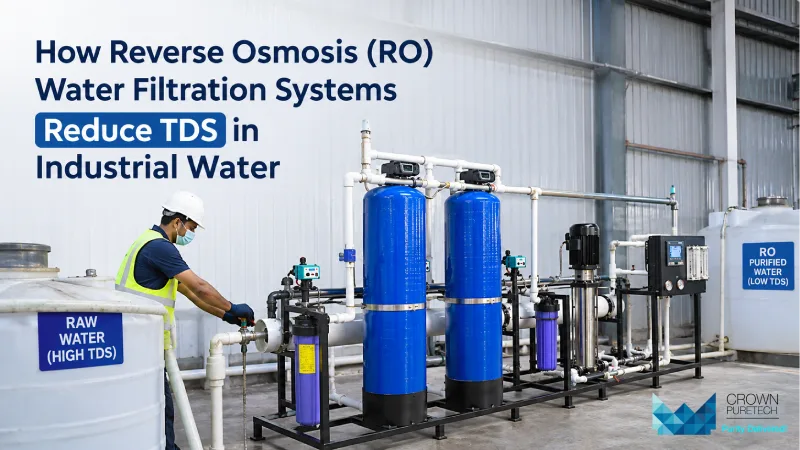
Crown Puretech is a provider of industrial RO water treatment systems in Gujarat. High Total Dissolved Solids (TDS) in industrial water can contribute to scaling, corrosion concerns, and process-quality problems, depending on which dissolved substances are present. Reverse Osmosis (RO) Water Filtration Systems reduce dissolved salts by passing pressurized water through specialized membranes. For factories using borewell or other high-TDS water sources, understanding the RO process helps in selecting suitable treatment capacity, pretreatment, and operating conditions.
What Is TDS and Why Is It Important in Industrial Water?
Total Dissolved Solids (TDS) represent the combined amount of dissolved minerals, salts, and other substances present in water.
Common dissolved constituents include calcium, magnesium, sodium, chloride, and sulfate ions.
TDS is generally expressed in milligrams per litre (mg/L) or parts per million (ppm) for dilute aqueous solutions.
Industrial facilities monitor TDS because water chemistry can affect equipment and manufacturing processes.
For example:
- Boilers: Dissolved minerals may contribute to deposits and other water chemistry problems.
- Cooling systems: Salt concentrations influence scaling and corrosion management.
- Manufacturing processes: Dissolved impurities may affect product quality.
- Cleaning operations: Water chemistry can influence residue formation.
- Water reuse systems: Dissolved solids can limit suitability for certain reuse applications.
However, a TDS measurement does not reveal the specific types of dissolved substances present in the water.
A high TDS reading indicates dissolved material, but a detailed water analysis is needed to understand the actual treatment requirement.
How Does an Industrial RO System Lower TDS Levels?
Reverse Osmosis (RO) systems use pressure to push water through a semipermeable membrane.
The RO membrane allows water molecules to pass through while removing a significant portion of dissolved salts and other impurities.
An industrial RO treatment arrangement generally includes these stages:
- Feed-water collection: Water enters the system from the selected source.
- Pretreatment: Filters, softeners, or chemical conditioning are used where required.
- Pressure application: A high-pressure pump supplies water to the RO membrane.
- Membrane separation: Water passes through the membrane while concentrated dissolved substances remain in the reject stream.
- Treated water collection: Lower-TDS permeate is collected for the intended application.
The concentrate stream carries the rejected impurities away from the membrane system.
Unlike ordinary sediment filters, RO membranes are specifically designed to reduce dissolved constituents.
How Much TDS Can Reverse Osmosis Remove?
The level of TDS reduction depends on the membrane type, feed-water composition, operating pressure, temperature, and system condition.
Many commercial RO membranes are capable of high dissolved-salt rejection under their specified operating conditions.
However, it is not appropriate to assume the same rejection percentage for every industrial installation.
Consider this illustrative example:
|
Water Parameter |
Example Value |
|
Feed-water TDS |
1,500 mg/L |
|
Assumed salt rejection |
95% |
|
Calculated permeate TDS |
Approximately 75 mg/L |
|
Required verification |
Actual membrane performance and water testing |
This is a calculation example, not a guaranteed specification for a particular Crown Puretech RO system.
Actual treated-water quality should be verified through testing.
Why Is Pretreatment Important Before RO?
Effective pretreatment helps protect the membrane from avoidable fouling and scaling.
Industrial water may contain suspended solids, hardness minerals, organic matter, or substances that damage the selected membrane material.
Depending on feed-water characteristics, pretreatment may include:
- Multimedia filtration for suspended particles
- Activated carbon filtration where appropriate
- Water softening or antiscalant dosing for scaling control
- Cartridge filtration for fine particulate removal
- Chemical conditioning for membrane compatibility
The selected stages depend on laboratory analysis and the membrane manufacturer's requirements.
Good pretreatment helps the RO membrane perform its intended separation function more consistently.
Poor pretreatment can cause pressure problems, declining permeate flow, increased cleaning requirements, and premature membrane replacement.
Where Do Factories Use Low-TDS RO Water?
Industrial facilities use RO-treated water for different purposes depending on the required water quality.
At Crown Puretech, we provide RO systems for commercial and industrial treatment applications.
Common industrial uses include:
- Process water: Manufacturing operations requiring controlled dissolved-solids levels.
- Boiler feed preparation: Pretreatment for further conditioning or demineralization where necessary.
- Food and beverage processing: Applications requiring specified incoming water quality.
- Pharmaceutical facilities: Pretreatment for additional purification stages.
- Equipment washing: Applications where dissolved mineral residues are undesirable.
RO-treated water is not automatically suitable for every high-purity application.
Additional technologies such as electrodeionization, demineralization, UV treatment, or other validated processes may be needed.
How to Select the Right Industrial RO Capacity
An industrial RO plant should be sized according to the required treated-water volume and operating schedule.
For example, a factory requiring 10,000 litres of treated water over 10 operating hours would need an average permeate production rate of 1,000 litres per hour.
However, this basic calculation is only a starting point.
System design must also consider feed-water availability, membrane recovery, storage requirements, operating interruptions, and cleaning arrangements.
Buyers searching for a Reverse Osmosis (RO) Water Filtration Systems Manufacturer in Ahmedabad should prepare the following information:
- Daily treated-water requirement
- Feed-water TDS and laboratory analysis
- Required outlet-water quality
- Available plant operating hours
- Site space and electrical conditions
- Concentrate discharge or reuse arrangements
Our listed RO equipment includes a 500–1,000 LPH capacity range for a specified product configuration, alongside fully automatic operation.
Different applications may require different configurations.
What Affects RO Membrane Performance?
Industrial RO performance changes with operating conditions.
One common problem is membrane fouling, which occurs when deposits accumulate on the membrane surface or within membrane channels.
Potential causes include suspended particles, biological growth, mineral scaling, and organic contamination.
Operators should monitor:
- Feed and permeate pressure
- Permeate flow rate
- Feed-water and treated-water conductivity
- Concentrate flow and system recovery
- Pressure drop across membrane stages
A rising permeate TDS reading may indicate membrane damage, seal leakage, operating changes, or another performance issue.
Correct diagnosis is important before replacing membranes.
Why Choose Us?
At Crown Puretech, we help industrial customers select RO water treatment systems based on actual water quality, treatment capacity, and application requirements. As a provider serving customers looking for a Reverse Osmosis (RO) Water Filtration Systems Manufacturer in Gujarat, we focus on practical system design, suitable pretreatment, and operational reliability. Our team can assist with feed-water assessment, equipment selection, installation requirements, and maintenance planning to support consistent industrial water treatment performance.
Conclusion
Reverse Osmosis (RO) Water Filtration Systems reduce TDS by separating dissolved salts from water through semipermeable membranes under pressure.
For industrial plants, this technology can help achieve the lower dissolved-solids levels required by certain processes and equipment.
However, successful RO operation depends on more than membrane selection. Feed-water testing, pretreatment, plant capacity, operating pressure, and regular monitoring all influence performance.
Factories should establish their required treated-water quality before selecting equipment.
Working with an experienced Reverse Osmosis (RO) Water Filtration Systems Manufacturer in Gujarat can help identify a suitable configuration for the facility's actual requirements.
Need an industrial RO system to reduce TDS in your factory's water supply?
Contact Crown Puretech to discuss your feed-water analysis, required capacity, and industrial water quality objectives.
Call: +91 98987 79911
Email: sales@crownpuretech.com
Share your water treatment requirements with our team and explore a suitable industrial RO solution.
Frequently Asked Questions
01What is the role of Reverse Osmosis (RO) Water Filtration Systems in reducing TDS?
Reverse Osmosis (RO) Water Filtration Systems reduce Total Dissolved Solids (TDS) by using pressure to push water through a semipermeable membrane. This process allows water molecules to pass while filtering out a significant portion of dissolved salts and impurities.
02How can I choose a Reverse Osmosis (RO) Water Filtration System Manufacturer in Ahmedabad?
When selecting a Reverse Osmosis (RO) Water Filtration Systems Manufacturer in Ahmedabad, consider your daily treated-water requirements, feed-water TDS level, outlet-water quality needs, and available operating hours. Providing detailed information helps ensure you select a suitable system for your facility's needs.
03Why is pretreatment necessary before using Reverse Osmosis systems?
Pretreatment is crucial for protecting RO membranes from fouling and scaling caused by suspended solids, hardness minerals, and other contaminants in industrial water. Implementing effective pretreatment helps maintain membrane performance and extends its operational lifespan.
04What factors influence the performance of Reverse Osmosis membranes?
The performance of Reverse Osmosis membranes is influenced by factors such as operating pressure, feed-water quality, temperature, and potential fouling from particles or biological growth. Regular monitoring of membrane performance is essential to diagnose issues and maintain system efficiency.
05Where are low-TDS RO water applications commonly used in industries?
Low-TDS RO water is widely used in various industrial applications, including process water for manufacturing, boiler feed preparation, food and beverage processing, and washing equipment. Each application may require specific water quality standards to ensure optimal operational performance.