Key Takeaways
- Understand your factory's water requirements to choose the right Industrial Water Treatment Plant for optimal efficiency.
- Evaluate raw water quality parameters like TDS, hardness, and turbidity before selecting a treatment system.
- Different water treatment technologies address specific contaminants; select based on your factory's unique needs.
- Calculate daily water demand and peak flow to ensure your Industrial Water Treatment Plant meets actual consumption.
- Consider automation and maintenance needs to ensure consistent performance and reliability of your water treatment system.
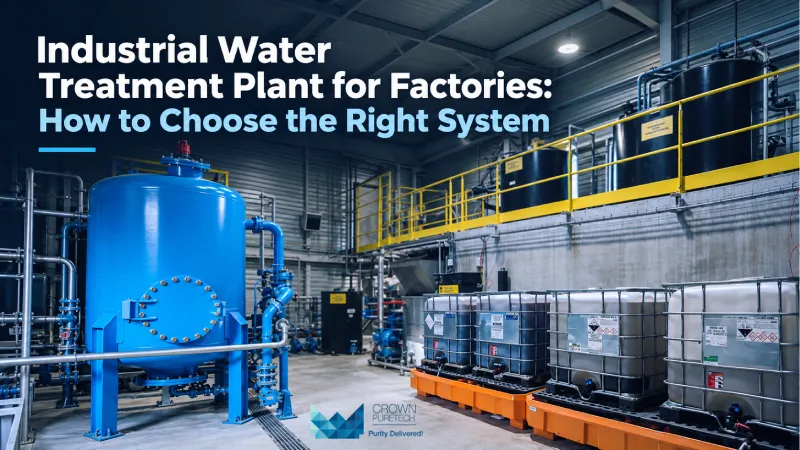
Crown Puretech is a leading manufacturer and provider of industrial water treatment plants in Gujarat. Water quality directly affects factory equipment, production processes, and maintenance requirements.
Choosing the right Industrial Water Treatment Plant helps industries control impurities, reduce operational disruptions, and maintain suitable process water quality. If you are searching for an Industrial Water Treatment Plant in ahmedabad, understanding your factory's water requirements is the first step towards making the right investment.
Why Factories Need the Right Water Treatment Plant
Industrial facilities use water for manufacturing, cleaning, cooling, heating, and other operations. However, untreated water may contain suspended particles, dissolved salts, hardness minerals, iron, and other impurities.
These contaminants can create equipment scaling, pipeline blockages, corrosion risks, and inconsistent process water quality.
A properly selected Industrial Water Treatment Plant treats the specific contaminants affecting your operations instead of relying on unnecessary treatment stages.
The objective is simple: Supply water that meets the factory's actual operational and process requirements.
Step 1: Understand Your Factory's Raw Water Quality
Before selecting a treatment system, factories should assess the quality of their incoming water.
Borewell water, municipal water, and surface water may require different treatment methods. A system suitable for one source may not deliver the required results for another.
Important parameters to check include:
- Total Dissolved Solids (TDS): Represents the total amount of dissolved minerals, salts, and other substances present in water.
- Water hardness: Identifies calcium and magnesium levels responsible for scaling.
- Turbidity: Measures the cloudiness caused by suspended particles.
- Iron content: Helps identify potential staining and deposits.
- pH Levels: Measure the acidity or alkalinity of water.
- Microbiological quality: Identifies potential contamination when relevant to the application.
As a provider of Industrial Water Treatment Plant in ahmedabad solutions, we recommend evaluating raw water quality before finalizing the treatment process.
Step 2: Choose the Right Industrial Water Treatment Technology
Different factories require different water treatment technologies. Selecting the correct combination depends on the contaminants present and the desired treated water quality.
At Crown Puretech, we offer solutions including reverse osmosis systems, water softeners, media filtration, ultrafiltration, UV treatment, and demineralization systems.
The following comparison explains their primary applications:
| Treatment Technology | Primary Function | Suitable Application |
|---|---|---|
| Reverse Osmosis (RO) | Reduces dissolved salts and other contaminants | Industrial process water |
| Water Softener | Removes calcium and magnesium hardness | Boilers and utility systems |
| Pressure Sand Filter | Reduces suspended particles and turbidity | Water pretreatment |
| Activated Carbon Filter | Reduces chlorine and certain organic compounds | Filtration and pretreatment |
| Ultrafiltration (UF) | Removes fine particles and microorganisms | Process water pretreatment |
| Demineralization (DM) | Removes dissolved ionic minerals | High-purity industrial water |
The right technology depends on what needs to be removed, not simply the type of factory.
Some facilities may require multiple treatment stages to achieve their desired water quality.
Step 3: Calculate Water Capacity and Daily Demand
An Industrial Water Treatment Plant should match the factory's actual water consumption and operating schedule.
An undersized system may struggle to meet peak demand, while unnecessary treatment capacity can complicate plant operation.
Our team considers several factors during system selection:
- Daily water consumption: Calculate the total volume required for industrial operations.
- Peak flow demand: Identify periods when water usage is highest.
- Operating hours: Determine whether the plant must run continuously or in scheduled shifts.
- Treated water requirements: Establish the water quality needed for each application.
- Future expansion: Consider whether production growth may increase water demand.
These details help determine suitable plant capacity, treatment stages, and storage requirements.
Step 4: Evaluate Automation and Maintenance Requirements
Industrial treatment systems require regular monitoring to maintain consistent performance.
When choosing an Industrial Water Treatment Plant in ahmedabad, factories should evaluate operational controls, maintenance accessibility, and after-sales technical support.
Important considerations include:
- Availability of suitable automatic controls and monitoring instruments.
- Accessibility of filters, membranes, valves, and other service components.
- Requirements for cleaning, regeneration, and consumable replacement.
- Availability of trained technical support.
- Provision for routine water quality testing.
- Suitable arrangements for wastewater, reject water, or regeneration discharge.
A maintainable treatment system supports more reliable factory operations over time.
Step 5: Choose a Manufacturer That Understands Industrial Applications
Factory water treatment requirements vary across pharmaceuticals, food processing, textiles, chemicals, engineering, and other industries.
Working with an experienced manufacturer helps businesses identify suitable equipment rather than selecting a standard configuration without assessing their needs.
At Crown Puretech, our services include consultation, design, installation, commissioning, operation and maintenance, water assessment, and annual maintenance support.
We focus on matching treatment systems with incoming water conditions, required output quality, and operating requirements.
Why Choose Us
At Crown Puretech, we understand that every factory has different water treatment challenges. We offer industrial RO systems, water softeners, filtration equipment, and other treatment solutions designed for diverse industrial applications. Our team supports businesses from initial water assessment and system selection to installation and maintenance. Whether your facility needs to control dissolved salts, reduce hardness, or improve filtration, we help identify practical treatment solutions based on water quality, plant capacity, and operational requirements.
Conclusion
The selection of an appropriate Industrial Water Treatment Plant requires an analysis of the source of water for the factory, level of contamination, and daily water requirement. The plant must be chosen on the basis of appropriate treatment technologies, capacity, automation, and maintenance facilities available.
Appropriate selection can lead to reduced scaling and equipment protection as well as improvement in quality of process water.
The choice of Industrial Water Treatment Plant in Ahmedabad by an industrial company can be made easy if done through a manufacturer who understands industrial requirements.
Sufficiency of water treatment for the factory is critical.
Looking for an industrial water treatment solution tailored to your factory?
Contact Crown Puretech to discuss your raw water quality, treatment capacity, and industrial process requirements. Our team can help you choose the right system for your facility.
Call: +91 98987 79911
Email: sales@crownpuretech.com
Connect with our team today and find the right water treatment solution for your factory.
Frequently Asked Questions
1. What is an Industrial Water Treatment Plant?
An Industrial Water Treatment Plant is a facility designed to treat water used in industrial processes by removing impurities and contaminants. This ensures that the water meets the quality requirements for various applications, such as manufacturing, cleaning, and cooling.
2. How do I choose the right Industrial Water Treatment Plant in Ahmedabad?
Choosing the right Industrial Water Treatment Plant in Ahmedabad involves assessing your factory's raw water quality, identifying the contaminants present, and understanding your water treatment needs. Consulting with a manufacturer experienced in industrial applications can also guide you in selecting the appropriate technology and capacity.
3. What are the common types of water treatment technologies for industrial use?
Common water treatment technologies for industrial use include reverse osmosis (RO), water softeners, media filtration, ultrafiltration, UV treatment, and demineralization systems. Each technology targets specific contaminants and is suitable for different applications based on the water quality requirements.
4. Why is it important to evaluate water quality before selecting a treatment system?
Evaluating water quality is crucial before selecting a treatment system because different sources of water, such as borewell, municipal, or surface water, may contain different contaminants. Understanding parameters like Total Dissolved Solids (TDS), hardness, turbidity, and pH levels helps tailor the treatment solution to the specific needs of your factory.
5. What should I consider regarding maintenance when choosing an Industrial Water Treatment Plant?
When choosing an Industrial Water Treatment Plant, consider factors like the accessibility of components for maintenance, the availability of automatic controls, and the need for routine water quality testing. Efficient maintenance ensures consistent performance and prolongs the lifespan of the treatment system.