Key Takeaways
- Ozone Generator Air Purifier uses chemical oxidation to treat air, not mechanical filtration methods.
- Safety is crucial; avoid using ozone generators in occupied spaces due to respiratory risks.
- Ozone generators can be effective for odor management but may produce harmful byproducts.
- Selecting the right Ozone Generator Air Purifier requires understanding specifications and intended applications.
- Ozone Generator Air Purifiers utilize chemical oxidation to effectively manage odors but do not filter particles like dust and pollen.
Crown Puretech is a leading manufacturer and exporter of ozone-based air treatment equipment. As an Ozone Generator Air Purifier Manufacturer, we provide ozonizer systems designed for specialized air treatment applications. Unpleasant odors and air quality concerns often lead buyers to explore ozone technology. However, understanding how ozone works, where it may be useful, and its safety limitations is essential before selecting a system.
What Is an Ozone Generator Air Purifier?
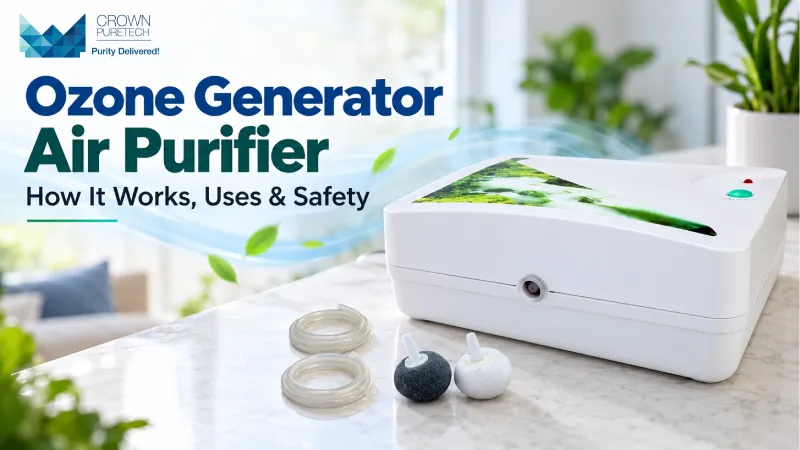
An Ozone Generator Air Purifier is a device that produces ozone (O₃), a gas consisting of three oxygen atoms. Ozone is a reactive oxidizing agent capable of interacting chemically with certain airborne compounds.
Unlike conventional filtration systems that capture particles, ozone generators release a gas into the treatment environment.
Ozone can react with some odor-producing substances, but its effectiveness depends on the contaminants, ozone concentration, and treatment conditions. It does not physically filter dust, pollen, or other airborne particles.
How Does an Ozone Generator Work?
Ozone generation uses electrical energy to convert oxygen molecules into ozone. Some ozone-generation technologies use ultraviolet radiation, while others rely on electrical discharge.
The process involves four main stages:
- Oxygen intake: Oxygen-containing air enters the ozone-generation system.
- Ozone production: Electrical energy splits some oxygen molecules, allowing oxygen atoms to recombine and form ozone.
- Ozone release: The generated gas enters the designated treatment environment.
- Oxidation reaction: Ozone interacts with certain compounds, potentially changing their chemical composition.
Ozone treatment relies on chemical oxidation rather than physical particle filtration.
The outcome depends on exposure time, concentration, airflow, and the substances present. Some reactions can also produce undesirable secondary pollutants.
Where Are Ozone Generators Used?
An experienced Ozone Generator Air Purifier Manufacturer can help buyers understand the differences between specialized ozone applications and conventional indoor air purification.
Ozone-generating equipment may be considered for controlled treatment processes in:
- Commercial facilities: Specialized odor-treatment activities in restricted, unoccupied spaces.
- Hospitality properties: Professionally managed treatment of certain persistent odor problems.
- Industrial environments: Controlled oxidation applications requiring technical evaluation.
- Property restoration: Selected odor-treatment procedures after the original contamination source has been addressed.
- Dedicated treatment chambers: Applications designed with appropriate ozone containment and exposure controls.
These uses require careful assessment. Ozone should not be released into normally occupied areas as a routine air-cleaning method.
Ozone Generator vs HEPA Air Purifier
Understanding the difference between ozone generation and mechanical filtration helps buyers choose the appropriate technology.
| Feature | Ozone Generator | HEPA Air Purifier |
|---|---|---|
| Working principle | Chemical oxidation | Physical particle filtration |
| Dust and pollen removal | Does not capture particles | Captures airborne particles |
| Odor management | Reacts with some compounds | Requires suitable gas-phase filtration for odors |
| Occupied room suitability | Not recommended | Generally suitable when properly operated |
| Main consideration | Ozone exposure and reaction byproducts | Filter quality and replacement |
For routine indoor air cleaning, appropriately sized filtration and ventilation are generally preferable to ozone generation.
Important Safety Precautions for Ozone Generators
Safety is the most important consideration when evaluating an Ozone Generator Air Purifier.
Ozone is a respiratory irritant. Exposure can cause coughing, throat irritation, chest discomfort, and breathing difficulties. People with asthma and other respiratory conditions may be particularly vulnerable.
Important precautions include:
- Do not operate ozone-generating equipment in occupied rooms.
- Keep people, pets, and other living organisms away from the treatment area.
- Follow equipment-specific operating and maintenance instructions.
- Use appropriate ozone monitoring and ventilation procedures.
- Confirm that ozone concentrations have returned to acceptable levels before allowing re-entry.
- Evaluate potential reactions with indoor materials and chemicals.
Ozone is not a substitute for ventilation, source removal, or HEPA filtration. Its use should be restricted to applications supported by an appropriate safety assessment.
How to Select the Right Ozonizer Equipment
Selection of a proper ozone generator involves assessing the technical data and application of the device.
The ozone generator specified by Crown Puretech has the following technical data: 600 mg/hour of ozone flow rate, semi-automatic control, ABS plastic enclosure, and air cooling. This data specifies the technical characteristics of the equipment and does not guarantee the applicability to a specific room or application.
In case of interaction with the Ozone Generator Air Purifier Manufacturer, potential customers need to consider the parameters such as ozone generation, equipment controls, application, maintenance, and exposure management.
We may assist the customer in the assessment of the specified equipment specifications.
Why Choose Us
We at Crown Puretech strive to supply our customers with high-quality ozone generating machines with detailed product specifications and application-based guidelines. We know that choosing the right air purifying machine is not just about understanding its performance but also safety. Being a trusted Ozone Generator Air Purifier Manufacturer, we provide our compact, semi-automatic ozonizer to help you decide on specialized ozone application.
Conclusion
The Ozone Generator Air Purifier functions through the generation of ozone that is capable of reacting chemically with certain elements within the atmosphere. The technology has particular uses, but its usefulness depends on the treatment process.
However, ozone generators cannot act as alternatives to normal filters for dust and other particles. They should not be used in occupied areas since ozone has effects on the lungs.
At Crown Puretech, we feel that it is important for clients to know what ozone generation technology is capable of, and not capable of. The first step for making a purchase is by reviewing product specifications.
Looking for ozone-generation equipment for a specialized air treatment application?
Contact Crown Puretech today to discuss your requirements, review ozonizer specifications, and find out whether our equipment is appropriate for your intended use.
Call: +91 98987 79911
Email: sales@crownpuretech.com
Connect with our team for product details and application guidance.
Frequently Asked Questions
1. What is an Ozone Generator Air Purifier?
An Ozone Generator Air Purifier is a device that produces ozone (O₃) to interact chemically with certain airborne compounds. Unlike traditional filters that capture particles, it releases ozone into the environment to help manage odors and improve air quality.
2. How does an Ozone Generator work?
An ozone generator works by converting oxygen molecules into ozone through electrical energy or ultraviolet radiation. This process involves several stages: intake of oxygen, ozone production, ozone release, and oxidation reaction with airborne contaminants.
3. What are the safety precautions for using Ozone Generator Air Purifiers?
Safety precautions include not operating the generator in occupied spaces, keeping people and pets away, and monitoring ozone levels. It's essential to follow the manufacturer's instructions and confirm that ozone levels are safe before allowing re-entry into treated areas.
4. Where are ozone generators typically used?
Ozone generators are used in commercial facilities for odor treatment, hospitality properties for persistent odor problems, and industrial environments where controlled oxidation is needed. They should only be used in unoccupied areas under careful assessment.
5. What should I consider when selecting an Ozone Generator Air Purifier?
When selecting an ozone generator, consider factors such as ozone generation capacity, application suitability, maintenance requirements, and safety management. It's crucial to evaluate the specific needs of your environment to ensure you choose the right system.