

Key Takeaways
- An advanced demineralization plant reduces scaling and corrosion, improving equipment reliability and lowering maintenance costs.
- Using a demineralization water treatment plant increases efficiency by ensuring high-purity water quality for industrial operations.
- Lower energy consumption and better heat transfer are key benefits of a water demineralization (DM) plant in Ahmedabad.
- By preventing mineral deposits, demineralization plants extend machinery lifespan and reduce unexpected equipment downtime.
- Consistent water quality from an advanced demineralization plant leads to reduced operational downtime and long-term savings.
Water quality plays a critical role in industrial operations. Industries such as pharmaceuticals, power generation, chemicals, textiles, food processing, and manufacturing rely heavily on purified water for production processes, equipment operation, and product quality. However, untreated water often contains dissolved salts, minerals, and impurities that can lead to scaling, corrosion, equipment damage, and increased maintenance expenses. These challenges significantly impact operational efficiency and profitability.
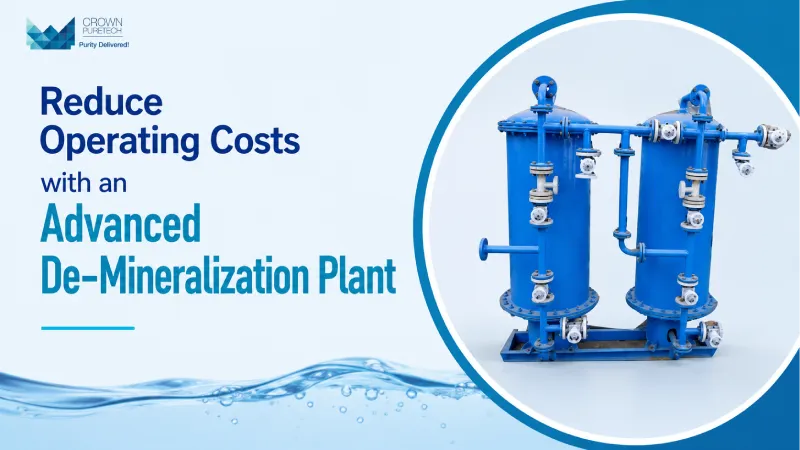
An advanced demineralization plant offers a practical and cost-effective solution for industries seeking high-purity water while reducing long-term operating costs. By removing dissolved minerals and ionic contaminants from water, a demineralization system helps maintain equipment performance, extend machinery lifespan, and lower energy consumption.
At Crown Puretech, we understand the importance of reliable water treatment solutions for industrial applications. Our advanced demineralization systems are designed to provide consistent water quality while helping businesses optimize operational expenses and improve productivity.
Understanding a De-Mineralization Plant
A demineralization plant is a type of water purification plant, which is particularly suitable for the removal of mineral salts and ions from water. The process is normally one of ion exchange technology in which unwanted ions like calcium, magnesium, sodium, chloride, sulphates and nitrates are exchanged by hydrogen and hydroxyl ions.
Pure water is created from these ions. In many industries, good quality water is required for the process, and it is essential to use a demineralization water treatment plant to meet the required quality of the water in the process and product. Demineralization plants differ from the ordinary filtration plants in that they remove dissolved solids that can't be filtered out.
The resulting demineralized water is suitable for applications such as:
- Boiler feed water
- Cooling towers
- Pharmaceutical manufacturing
- Chemical processing
- Laboratory operations
- Electronics manufacturing
- Textile processing
With an advanced demineralization solution, industries can greatly diminish the operational issues that can occur due to water quality issues.
Why Water Quality Directly Impacts Operating Costs
Numerous companies underestimate the economic consequences of poor water quality. Untreated water contains minerals that eventually settle on equipment surfaces, forming scale and decreasing heat transfer efficiency and energy usage. The common problems of mineral water which are associated with its cost include:
Increased Energy Consumption
Scale deposits are an insulating layer on heat exchangers and boilers. This results in higher energy being needed to get the performance levels desired on their systems.
Frequent Maintenance
Mineral deposits can cause pipelines, valves, and equipment to become clogged, leading to frequent cleaning and repairs. Systems have become less efficient, resulting in higher maintenance costs.
Equipment Downtime
Unexpected breakdowns -- caused by corrosion and scaling -- disrupt production schedules and result in revenue losses.
Shortened Equipment Lifespan
Water that's loaded with minerals can cause accelerated wear and tears, ultimately shortening the lifespan of industrial equipment.
The use of an advanced demineralization plant can tackle these problems effectively by providing water with very low dissolved solids content, which minimizes maintenance needs and enhances the reliability of the system.
How an Advanced De-Mineralization Plant Reduces Costs
Reduced Scaling and Corrosion
A major advantage of a demineralization water treatment plant is that it is able to prevent scaling and corrosion. This reduces the dissolved salts and hardness-causing minerals in the system, thereby safeguarding the critical equipment from damage.
This protection translates into:
- Lower maintenance expenses
- Fewer repair requirements
- Improved equipment reliability
- Extended machinery lifespan
Improved Boiler Efficiency
One of the most critical systems in industry in terms of water quality is boilers. Thin layer of scale can have a significant effect on heat transfer efficiency. Water from a demineralization plant can be used to keep boiler surfaces clean which leads to:
- Lower fuel consumption
- Improved heat transfer
- Reduced operating costs
- Better steam quality
Lower Chemical Treatment Costs
Chemicals are frequently used to prevent scaling, corrosion, and biological growth in water systems in industries. If a demineralization water treatment plant works well, the chemicals required for additional treatment can be greatly minimized.
This leads to:
- Reduced chemical purchasing costs
- Lower handling and storage requirements
- Improved environmental compliance
Enhanced Process Efficiency
High-purity water improves consistency across industrial processes. Whether used in manufacturing, cleaning, or product formulation, demineralized water helps maintain quality standards while minimizing waste.
The result is improved production efficiency and reduced operational losses.
Key Components of an Advanced De-Mineralization Plant
Modern demineralization systems are designed with advanced technologies to deliver reliable performance and operational efficiency.
Cation Exchange Unit
This unit removes positively charged ions (such as calcium, magnesium, sodium and iron) and replaces them with hydrogen ions.
Anion Exchange Unit
Anion exchanger can be used to extract negatively charged ions like chloride, sulfate, nitrate and bicarbonate, replacing them with hydroxyl ions.
Mixed Bed Polisher
A mixed bed unit is used for the final polishing to obtain very high water purity levels needed for sensitive industrial applications.
Regeneration System
During the regeneration process, the system's ability to regenerate resin will restore resin capacity, enabling consistent performance for long periods.
In Crown Puretech each demineralization water treatment plant is equipped with quality components and optimized configurations as per the requirement of each industry.
Industries That Benefit from De-Mineralization Plants
Power Plants
High purity water is needed to operate power generation facilities. Scale formation and corrosion can be prevented by a demineralization plant, which will reduce the operational expenses.
Pharmaceutical Industry
The pharmaceutical industry has very stringent water quality standards. Demineralized water helps to ensure product purity and regulatory compliance.
Chemical Processing
Demineralized water is used in the production process in the chemical industry where the presence of minerals in the water may result in a change in the product quality.
Textile Industry
Water quality directly influences dyeing and finishing processes. A demineralization water treatment plant helps achieve consistent product quality.
Food and Beverage Industry
Purified water is needed for many food processing operations to ensure hygienic conditions and product uniformity.
Electronics Manufacturing
During the manufacturing and cleaning operations, very high purity water is often needed for electronic components.
Why Businesses Prefer Water Demineralization Systems
Industries today are concerned with cutting down cost of operation while enhancing the productivity. Here, a Water Demineralization (DM) Plant in Ahmedabad can be beneficial investments.
The benefits include:
- Reduced energy consumption
- Lower maintenance costs
- Improved product quality
- Better equipment performance
- Increased process reliability
- Reduced operational downtime
- Long-term cost savings
The Water Demineralization (DM) Plant designed and installed in Ahmedabad can provide measurable financial benefits and contributes towards sustainable industrial operations.
Why Choose Us
Crown Puretech has established itself as a trusted provider of industrial water treatment solutions by focusing on quality, reliability, and customer satisfaction. Our expertise in designing and manufacturing advanced demineralization systems allows us to deliver solutions that address the unique needs of various industries. Every demineralization plant developed by Crown Puretech is engineered for efficient performance, reduced operating costs, and long-term durability. With a commitment to innovation, technical excellence, and responsive customer support, Crown Puretech helps businesses achieve superior water quality while optimizing operational efficiency and protecting valuable industrial assets.
Conclusion
An advanced demineralization plant is a strategic investment for industries seeking to reduce operating costs, improve equipment performance, and maintain consistent water quality. By removing dissolved minerals and impurities, a modern demineralization water treatment plant helps minimize scaling, corrosion, maintenance expenses, and energy consumption. As industries continue to prioritize efficiency and sustainability, the demand for reliable solutions such as a Water Demineralization (DM) Plant in Ahmedabad continues to grow. Crown Puretech delivers advanced water treatment solutions designed to support long-term productivity, operational reliability, and cost-effective industrial performance across a wide range of applications.
Looking to reduce industrial operating costs with an advanced demineralization solution? Contact Crown Puretech today at +91 98987 79911 or email sales@crownpuretech.com