Key Takeaways
- Alkaline Water Ionizer Machines adjust water pH through electrolysis, while RO purifiers primarily remove dissolved contaminants.
- Choosing between an Alkaline Water Ionizer Machine and RO purifier depends on your water quality and specific needs.
- Alkaline Water Ionizer Machines are not designed to reduce TDS, making RO purifiers more suitable for high-TDS water.
- Always test your source water quality before deciding on a water treatment system for optimal results.
- Combine technologies for a comprehensive solution, utilizing both purification and ionization for enhanced water quality.
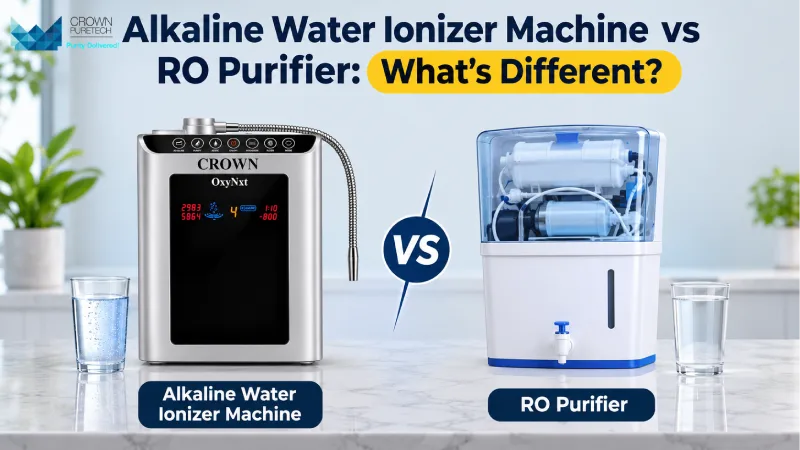
Crown Puretech is a leading provider of water treatment solutions, including alkaline water ionizer machines and RO purification systems. Both technologies are used in drinking water treatment, but they serve different purposes. An RO purifier primarily removes dissolved contaminants, while an Alkaline Water Ionizer Machine changes water pH through electrolysis. Understanding this difference helps you choose a system based on your actual water quality and requirements.
Alkaline Water Ionizer vs RO Purifier: Key Differences
Before choosing a water treatment system, it's important to understand what each technology actually does.
|
Feature |
Alkaline Water Ionizer |
RO Water Purifier |
|
Main purpose |
Adjusts water pH |
Removes dissolved contaminants |
|
Technology |
Electrolysis |
Reverse osmosis membrane |
|
TDS reduction |
Not its primary function |
Reduces dissolved solids |
|
Water pH |
Produces different pH outputs |
Depends on source water and treatment |
|
Water output |
Alkaline and acidic streams |
Purified water and reject water |
|
Maintenance |
Filters and electrode cleaning |
Filter and membrane replacement |
The biggest difference is simple: RO focuses on purification, while an alkaline ionizer focuses on changing water characteristics.
Some systems combine both processes, allowing water to undergo purification before ionization.
How Does an Alkaline Water Ionizer Machine Work?
An Alkaline Water Ionizer Machine uses electrolysis to change the pH of water. Depending on the model, incoming water first passes through filtration before entering an electrolysis chamber.
Inside the chamber, electrodes use electrical energy to produce water streams with different pH levels.
The process involves four stages:
- Water filtration: Incoming water passes through the installed filters to reduce specified impurities.
- Electrolysis: Electrical energy drives reactions that change the water's pH.
- Water selection: Users choose an available setting through the machine's controls.
- Water output: The machine produces water suited to the selected setting and intended application.
Unlike RO membranes, electrolysis alone does not provide comprehensive removal of dissolved contaminants.
This is why the incoming water quality and the machine's filtration capabilities are important.
How Does an RO Water Purifier Work?
Reverse osmosis uses pressure to push water through a semipermeable membrane. The membrane separates a significant portion of dissolved salts and other contaminants from the incoming water.
An RO purification system typically involves:
- Pre-filtration: Reduces sediment and certain substances that could affect the membrane.
- RO membrane: Separates many dissolved contaminants from the water.
- Purified Water Outlet: Delivers treated water for its designated application.
- Reject water outlet: Carries away concentrated contaminants.
RO is particularly useful when water contains elevated Total Dissolved Solids (TDS) or specific contaminants that the selected membrane can reduce.
However, RO performance depends on membrane quality, water pressure, pretreatment, maintenance, and the contaminants present.
Which System Is Better for High-TDS Water?
If your water contains high TDS, an RO purifier is generally the more relevant technology because its membrane is designed to reduce dissolved salts.
An alkaline ionizer changes pH but does not automatically remove excess dissolved salts.
For example, if your water source contains elevated dissolved minerals, adjusting its pH will not solve the underlying TDS problem.
Water purification should come before pH customization when the source water requires contaminant removal.
As an Alkaline Water Ionizer Machine Manufacturer in Gujarat, we recommend evaluating the incoming water quality before choosing any treatment configuration.
A basic water analysis can help determine whether RO purification, filtration, ionization, or a combination is appropriate.
Is Alkaline Water Healthier Than RO Water?
This is a frequently raised question among potential buyers.
Alkaline water has a pH above 7, but a higher pH does not automatically make drinking water healthier or safer.
Some alkaline water products are promoted for improved hydration, antioxidant activity, and other wellness benefits. However, strong clinical evidence supporting broad health claims remains limited.
Similarly, RO water is not automatically better for every household. Its value depends on the quality of the incoming water and the contaminants that need to be removed.
Rather than choosing a system based on health-related marketing claims, focus on tested water quality, reliable treatment performance, and your actual drinking water requirements.
Can an Alkaline Ionizer and RO Purifier Work Together?
Yes. Both technologies can be included in one water treatment arrangement when the system is designed for that purpose.
RO can reduce dissolved contaminants, while the ionization stage can produce water with different pH characteristics.
At Crown Puretech, our alkaline water ionizer product range includes filtration and electrolysis features. The product specifications also identify RO as a purification technique for the listed configuration.
Depending on the model, available features include:
- Dual filtration arrangement
- Platinum-coated titanium electrodes
- Touch LCD controls
- Multiple water settings
- Automatic cleaning and diagnostic functions
The exact features and treatment arrangement should be confirmed for the selected model.
What Should You Check Before Buying?
When selecting equipment from an Alkaline Water Ionizer Machine Manufacturer, don't focus only on the number of pH settings or the appearance of the machine.
Check these practical factors before making a decision:
- Source water quality: Test TDS and relevant contaminants.
- Filtration capability: Understand which impurities the system is designed to reduce.
- pH settings: Check the available settings and their intended applications.
- Maintenance requirements: Review filter replacement and electrode cleaning instructions.
- Installation compatibility: Confirm available space, plumbing, and electrical requirements.
- Technical support: Ask about model specifications, operating guidance, and service availability.
These checks help avoid selecting a machine that cannot address your actual water quality concerns.
Why Choose Us?
At Crown Puretech, we understand that different water sources require different treatment approaches. As an Alkaline Water Ionizer Machine Manufacturer in Gujarat, we offer water treatment solutions that combine practical filtration technologies with user-friendly features. Our team helps customers understand the differences between RO purification and water ionization, review available equipment specifications, and select suitable configurations. We focus on clear technical information, appropriate system selection, and reliable support rather than unnecessary product claims.
Conclusion
An Alkaline Water Ionizer Machine and an RO purifier are not interchangeable technologies. RO is designed to reduce dissolved contaminants, while ionization adjusts water pH through electrolysis.
If your primary concern is high TDS or specific dissolved contaminants, an appropriate RO purification system may be the better starting point. If your water is already suitable for drinking and you want selectable pH settings, an alkaline ionizer may be worth considering.
Some configurations combine both technologies, but selecting the right system should always begin with water testing.
At Crown Puretech, we help customers make informed water treatment decisions based on their needs.
Looking for a reliable Alkaline Water Ionizer Machine Manufacturer?
Contact Crown Puretech to explore alkaline water ionizer features, understand available RO and ionization configurations, and discuss the right system for your water quality requirements.
Call: +91 98987 79911
Email: sales@crownpuretech.com
Get expert product guidance and choose a water treatment solution that fits your needs.
Frequently Asked Questions
01What is the main difference between an Alkaline Water Ionizer Machine and an RO purifier?
The main difference lies in their functions: an Alkaline Water Ionizer Machine focuses on adjusting the water's pH through electrolysis, while an RO purifier is designed to remove dissolved contaminants using a semipermeable membrane.
02Is alkaline water healthier than RO water?
While alkaline water has a pH above 7, a higher pH does not automatically equate to healthier drinking water. The health benefits of alkaline water are not extensively supported by scientific evidence, and the suitability of RO water depends on the specific contaminants present in your source water.
03Can an Alkaline Water Ionizer Machine and RO purifier be used together?
Yes, both technologies can be integrated into a single water treatment system. An RO purifier can first remove contaminants, and then the ionization process can adjust the pH of the purified water.
04What should I check before buying an Alkaline Water Ionizer Machine?
Before making a purchase, evaluate the source water quality, understand the filtration capability of the machine, check available pH settings, and review maintenance requirements. Ensure that the product is compatible with your plumbing and electrical setup.
05How does an Alkaline Water Ionizer Machine work?
An Alkaline Water Ionizer Machine uses electrolysis to change the pH of water. Incoming water first passes through filters and then enters the electrolysis chamber, where electrodes generate water streams with different pH levels, allowing for selectable outputs.