

Key Takeaways
- A demineralization plant effectively removes dissolved minerals to produce high-quality water for various industrial applications.
- Key components like cation and anion exchange vessels play crucial roles in the dm plant water treatment process.
- Understanding proper maintenance ensures longevity and efficiency of a demineralization water treatment plant.
- Crown Puretech offers tailored solutions for demineralization plants, enhancing operational reliability and water quality control.
- Automated systems in a demineralization plant minimize human error and optimize regeneration processes.
Water quality plays a crucial role in industrial processes, manufacturing operations, power generation, pharmaceuticals, food processing, and many other applications. Water containing dissolved minerals such as calcium, magnesium, sodium, chloride, and sulphates can affect equipment performance, product quality, and operational efficiency. For industries that require highly purified water, a standard filtration process may not be sufficient. This is where advanced mineral removal technologies become important.
A demineralization plant is an advanced water treatment system designed to remove dissolved salts and mineral ions from water, producing high-quality demineralized water suitable for industrial applications. Through ion exchange technology, these plants reduce unwanted dissolved impurities and provide water with low mineral content. A properly designed demineralization water treatment plant helps industries maintain process efficiency, reduce scaling issues, and improve equipment reliability. Understanding the components involved in dm plant water treatment helps industries select the right solution according to their operational requirements. Crown Puretech provides efficient demineralization solutions designed for industrial and commercial water purification needs.
What Is a Demineralization Plant?
A demineralization plant is a water treatment plant that extracts mineral salts, such as calcium, magnesium, sodium, chlorides, sulphates, silica and others, from raw water with the help of ion exchange resins. A dm plant water treatment system removes practically all dissolved ions from water, unlike a softener which only replaces hardness ions with sodium, and an RO system, which uses membrane filtration. Consequently, this is the preferred option whenever even minute amounts of minerals are not desired, as in boiler feed lines, laboratory processes, battery and electronics production.Crown Puretech has been developing their demineralization systems for years and the following sections explain how these plants operate.
Key Components of a Demineralization Plant
1. Raw Water Feed and Pre-Treatment Unit
Water is first pre-treated before it ever reaches the resin vessels. This usually involves multi-grade sand filters and possibly activated carbon filters, if necessary, to remove suspended solids, turbidity and residual chlorine. This is necessary to prevent damage to the resin beads and to ensure a long working life for the demineralization plant when the water is to be fed directly into it instead of into the filtered or chlorinated demineralizer.
2. Cation Exchange Vessel
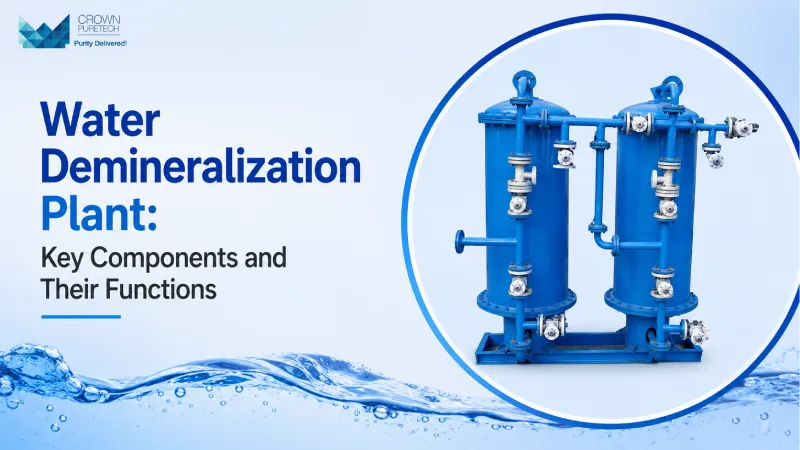
The cation vessel is usually the first ion exchange stage. It is filled with strongly acidic cation resin that exchanges positively charged ions — calcium, magnesium, sodium — for hydrogen ions. As water flows through the resin bed, these hardness-forming minerals are captured, and the water becomes acidic as hydrogen ions replace them. This stage is fundamental to any demineralization water treatment plant, since it removes the bulk of the dissolved cations before the water moves further into the system.
3. Degasser Tower (CO2 Remover)
Water may also contain dissolved carbon dioxide from the reaction of bicarbonates with the hydrogen ions of the dissociation reaction that occurred in the cation stage. This CO2 can be mechanically removed from the water before it enters the anion resin by a degasser tower, which may be equipped with a blower fan and diffusers for forced draft. If CO2 is removed at this stage, it will load the anion resin less and enhance the plant efficiency.
4. Anion Exchange Vessel
In the anion vessel the anion resin is strongly basic or weakly basic, and it will exchange the negative charges, such as chloride ions, sulphates, nitrates, silica ions, etc. with the hydroxyl ions. Together with the hydrogen ions of the cation stage, these hydroxide ions create pure water molecules and neutralize the acidity, thus finishing the main demineralization reaction. A classic two bed plant water treatment system is characterized by this two-resin combination.
5. Mixed Bed Polisher
A two-bed unit is followed by a mixed bed unit for applications requiring the highest possible degree of purity, e.g. pharmaceutical formulations or high-pressure boiler feed. It is a combination of both cation and anion resin in a single vessel and works as a series of dozens of polishing stages. This yields water of very low conductivity and is sometimes close to the theoretical purity limit of water itself.
6. Regeneration System
Ion exchange resins can have a limited capacity. After use they need to be replenished, the cation resin by dilute acid, typically hydrochloric or sulphuric acid and the anion resin by an alkali such as caustic soda. Chemical dosing tanks spent regenerant neutralization and dilution piping are part of the regeneration system. In a reliable demineralization plant, one of the most crucial points which differentiates it from a plant that requires constant manual intervention is the proper automation of the regeneration system.
7. Control Panel and Automation
Modern plants now have a PLC based or relay based control panel which measures conductivity, flow rate and resin depletion on a real-time basis. Automated systems minimize risk of human error, automatically initiate regeneration cycles, and enable one operator to control the entire system. This is a characteristic feature of the DM systems supplied by Crown Puretech, in which the compactness and single person operability have been integrated into the plant design.
8. Piping, Valves, and Instrumentation
All components are connected with each other by a series of pipes, multiport or single valves, pressure gauges and conductivity meters. The quality of these fittings is directly linked to the ability of years of operation to keep a demineralization water treatment plant leak-free, low-maintenance. The materials used here are corrosive resistant, thus increasing the working life of the whole system.
9. Storage and Distribution Tank
After passing through all the treatment stages, the water is collected in the specially designed demineralized water tank from where it is supplied to the point of use. This type of tank is usually made of corrosion resistant material to maintain the purity gained in the treatment process, as even a substandard storage tank can contaminate the water following all the treatment process.
Why Each Component Matters
Each component of a demineralization plant has a purpose and if one part is eliminated or under-designed it will affect the final water quality. If the pre-treatment filter is too small, it allows particulates to pass through and foul the resin bed.
If the degasser is too small, the CO2 remains in the water, and the anion resin has to do more work and regenerate more often. If the control panel is not automated, then the operator may either over-regenerate, wasting the chemicals, or under-regenerate, allowing impure water to flow into the process line.That's why it's generally much more effective to get a full dm plant treatment system from a single, experienced manufacturer rather than piecing it together with parts from a number of vendors.
Industries That Rely on Demineralization Plants
- Power generation: Boiler feed water free of scale-forming minerals prevents tube failures and extends turbine life.
- Pharmaceuticals and laboratories: Mineral-free water is essential for formulations, cleaning, and analytical accuracy.
- Electronics and battery manufacturing: Even trace ionic content can interfere with sensitive assembly processes.
- Textile and chemical processing: Consistent water quality protects dyes, chemicals, and finished product standards.
- Food and beverage processing: Where mineral content must be tightly controlled for product consistency.
Choosing the Right Demineralization Plant for Your Facility
Selecting a demineralization plant is not just about capacity in liters per hour. Buyers should look closely at the grade of resin used, the automation level of the control panel, the corrosion resistance of the vessels and piping, and whether the manufacturer offers after-sales support for resin replacement and regeneration chemicals. A plant built on wheels for mobility, with a compact single-person-operable layout, also makes a real difference in facilities where floor space and manpower are limited. Reviewing your raw water analysis with the manufacturer beforehand — TDS, hardness, silica content, and flow requirements — ensures the vessel sizing and resin quantity are matched correctly to your actual operating conditions rather than generic assumptions.
Maintenance Considerations
Long-term performance of any demineralization water treatment plant depends heavily on maintenance discipline. Regular monitoring of outlet conductivity indicates when resin beds are nearing exhaustion. Regeneration frequency should be tracked and logged, since inconsistent regeneration intervals are one of the most common causes of resin fouling. Periodic backwashing of pre-treatment filters, inspection of valves for leaks, and timely replacement of aged resin all contribute to keeping a dm plant water treatment system running at its designed efficiency for years rather than months.
Why Choose Us
Crown Puretech brings together engineering expertise, robust component sourcing, and a customer-first design philosophy in every demineralization plant it manufactures. Based in Ahmedabad, Gujarat, Crown Puretech builds systems that are compact, mobile, and simple enough for a single operator to control, without compromising on treatment quality or automation. From the initial water analysis to after-sales support for resin regeneration and maintenance, Crown Puretech stays involved through the entire lifecycle of the plant. This combination of technical depth and genuine service commitment is what has made Crown Puretech a trusted name for industries that simply cannot afford impure water reaching their process lines.
Conclusion
A demineralization plant is only as good as the sum of its components — pre-treatment, cation and anion vessels, degasser, mixed bed, regeneration system, and automation all have to work together seamlessly. Understanding each part helps facility owners ask the right questions before investing. Crown Puretech designs its DM systems with this complete-system approach, ensuring every component is matched for reliability, efficiency, and long-term ease of operation across industrial and process applications.
Need a demineralization plant built around your exact water analysis and flow requirements? Talk to Crown Puretech's engineering team today. Call +91 98987 79911 or email sales@crownpuretech.com